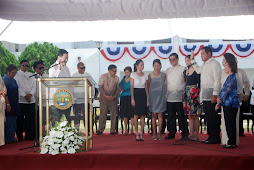
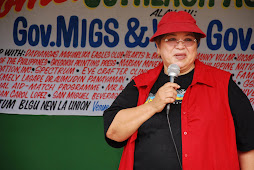
MAITUM, Sarangani (February 7, 2010) - Mayor Elsie Perrett assisted by Governor Migs Dominguez cuts the ribbon during the inauguration of Kipalkuda Elementary School library. (Cocoy Sexcion/SARANGANIINFORMATION OFFICE)
Showing posts with label Datu Wali Mission. Show all posts
Showing posts with label Datu Wali Mission. Show all posts
Monday, February 8, 2010
New Library
MAITUM, Sarangani (February 7, 2010) - Mayor Elsie Perrett assisted by Governor Migs Dominguez cuts the ribbon during the inauguration of Kipalkuda Elementary School library. (Cocoy Sexcion/SARANGANIINFORMATION OFFICE)

New books
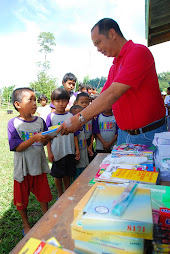
 MAITUM, Sarangani (February 7, 2010) - Mayor Elsie Perrett checks books of the newly inaugurated Kipalkuda Elementary School library.(Cocoy Sexcion/SARANGANI INFORMATION OFFICE)
Sunday, March 8, 2009
Notebooks
 MAITUM, Sarangani (March 6, 2009) – Provincial employees led by Governor Migs Dominguez and volunteers distribute notebooks to the pupils of Kipalkuda Elementary School in New La Union Thursday, March5. The school is where Tom Balatac, a 24-year old Grade 2 pupil and son of a farmer, is studying and never gives up his dream to become a lawyer. Tom has to walk two hours a day to attend school. (SARANGANIINFORMATION OFFICE/Cocoy Sexcion)
Thursday, February 5, 2009
Comfort room donation
 MAITUM, Sarangani (February 5, 2009) – American missionary Dan Evans (right) turns over keys of the donated comfort room (CR) to head teacher Aura Mirayo of Kipalkuda Elementary School. The new CR will provide greater sanitation and hygiene for the school property,students, and teachers. The school with 350 students in grades 1-6 islocated in barangay New La Union. The construction project was initiated and funded by the Datu Wali Mission of Maitum, with planning assistance by the Maitum municipal engineering department, and hands-on supervision by engineer Gilbert Rocapor. Datu Wali Mission directors, Dan and Aurea Evans, who sponsor other programs to assistthe children of Kipalkuda school, raised funds among their foundation supporters in the U.S. for the project. The CR follows a standard Unicef design, with all concrete walls and floor, and a dedicated septic tank. The original design was expanded to include two stalls in the female side of the CR, and a stall and urinal in the male section.Fresh water for flushing is supplied by a spring, and an outdoor faucet was incorporated for hand washing. (Photo courtesy of Datu WaliMission/MAITUM INFORMATION OFFICE)
Tuesday, March 11, 2008
Tsinelas campaign


MAITUM, Sarangani (March 11, 2008) - School children display their new tsinelas (slippers), part of the 800 pairs of slippers distributed Tuesday (Mar. 11) by the staff of top-rating weekly primetime program Rated K in its "tsinelas campaign" for elementary kids coming from remote villages who have to walk five to 10 kilometers going to school. (Photo by Afren de Guzman/MAITUM INFORMATION OFFICE)
Monday, December 17, 2007
Free medicines

MAITUM, Sarangani (December 16, 2007) – Medicines provided by medical representatives are given free at Kipalkuda Elementary School for children treated by Dr. Liza Gonzaga of General Santos City. The doctor did free consultation and medication Friday, December 14, to more than 300 school children. (Photo courtesy of Beth Palma Gil of MAITUM INFORMATION OFFICE)
Free medical service

MAITUM, Sarangani (December 16, 2007) – Dr. Liza Gonzaga, an affiliate of Socsargen County Hospital in General Santos City, treats a pupil in Kipalkuda Elementary School while a girl waits for her turn Friday, December 14, in barangay New La Union. Dr. Gonzaga, who has been doing her once-a-month free clinic for years around the region, treated the kids for free with free medicines. Dr. Gonzaga read about the plight of the Kipalkuda kids from the internet and from Atlanta-based Arjho Turner. (Photo courtesy of Beth Palma Gil MAITUM INFORMATION OFFICE)
Free lunch

MAITUM, Sarangani (December 16, 2007) – Parent-volunteers prepare lunch for pupils of Kipalkuda Elementary School Friday, December 14, in barangay New La Union. Some kids here are so poor that many begin the day without breakfast and cannot bring a lunch to school. Daniel Lee Evans and his wife Aurea Desaville set up the Datu Wali Mission Foundation (DWM) to facilitate education among tribal and poor children, using their family farm & school yard to plant vegetables for the T'boli pupils' free lunch program. Evans led the feeding program with the parents and the teachers to provide lunch for the children on school days. Parents alternately cook food to keep their children in school. The DWM provides rice, clothing, and transportation. (Photo courtesy of Beth Palma Gil of MAITUM INFORMATION OFFICE)
Monday, August 27, 2007
24-year old Grade I pupil dreams of becoming a lawyer
MAITUM, Sarangani (August 26, 2007) – "Kasi mahirap talaga ang pobre."
This statement sums up what motivated Tom Balatac, 24, to enroll in Grade I this year.
"Mahirap talaga ang walang pinag-aralan. Naranasan ko na, " said Balatac, single, the third among seven children of a farmer in the upland village of Kamaas.
Balatac walks an hour from his village to Kipalkuda Elementary School in New La Union (population: 1,232), a predominantly T'boli barangay. "Lahat ng mga kapatid ko graduate na sa high school. Ako lang ang hindi naka graduate. Kung may tumulong sa akin baka hanggang college ako," Balatac said. Balatac wishes to become a lawyer someday to help his community.
Despite his T'boli family's owning a 24-hectare farm, their living conditions remain poor and that urged him more to go to school.
Besides, Balatac and several children in Kipalkuda Elementary School have won back interest in schooling due to a school feeding program initiated by an American missionary and his wife.
Daniel Lee Evans and his wife Aurea Desaville set up the Datu Wali Mission Foundation (DWM) two years ago to facilitate education among tribal and poor children. "Education breaks the cycle of poverty," said Evans, 54, a retired executive of Bank of America in San Francisco.
According to the DWM website (http://www.datuwalimission.org/), the students live in the mountains above the school and walk up to four hours each way daily to attend classes. They cross up to seven streams and rivers and, because of that and the rainforest, they arrive at school wet and cold.
They are so poor that many begin the day without breakfast and most cannot bring a lunch to school. Those circumstances make class attendance very challenging and inconsistent.
At the appointed school lunch hour, nearly all of the students begin the long walk home since they have no lunch to eat. Not only does this create high absenteeism, but it demoralizes teachers as their classrooms are mostly empty in the afternoons, the DWM said.
Kipalkuda, which means a horse crossing a river in T'boli dialect, was the former name of this barangay. It was renamed "New" by Ilocano settlers from San Fernando, La Union in Luzon.
"We can't help a lot of people, but by coming to our children, I hope that one day, one of our children decides to come back as a professional and help their own people, and that's when we know our success," Evans said.
The Evans couple has used their family farm to plant vegetables for the T'boli pupils' free lunch program. "We looked at the community and we reached out to our friends back in America, and they are very helpful," Evans said. Evans led the feeding program with the parents and the teachers to provide lunch for the children on school days. Parents alternately cook food to keep their children in school. The DWM provides rice, clothing, and transportation. The municipal and provincial government units have donated school supplies and used clothing too. The program has encouraged children to go to school, marking a 220% increase in enrolment this school year.
There are a number of pupils who are already in their teens. The school today has 349 pupils, compared to 90 in 2004. A DWM truck ferries children to and from school everyday. The kids call it their "school bus." "It's amazing because, while the province has to extend the enrolment of some schools to see their population increasing, our school has more than doubled its enrollees," Evans said. "Our challenge now is providing these children with more chairs and a place (classrooms) to study," Evans said. Mayor Elsie Perrett said the municipal government was looking for funds "to assist the school in giving quality education to our children."
The local government has delivered 16 desks for the pupils. But these were not enough. Some pupils still sit four in a desk instead of two.
Two of Kipalkuda's school buildings need repair and were not safe to be used as classrooms. With only four teachers, Perrett said she has requested the Department of Education to assign more teachers in Kipalkuda."But first of all we have to encourage pupils to come to school and encourage older people to get interested to study and learn," the mayor said. Teacher-in-charge Aura Mirayo's T'boli roots helped convince children to enroll."Sabi ko lahat walang mayaman dito sa inyo. Lahat mahirap. Sabi ko ang solusyon dyan is pag-aaral lang," Mirayo told them. "Kailangan mag-aral kayo. Walang bata o matanda sa pag-aaral as long as gusto ninyong matuto." Kipalkuda Elementary School is now one of the top three performers throughout the municipality.
From the US, Josephine Turner said the Galing Foundation Inc. she's involved in in Atlanta has chosen Kipalkuda Elementary School as its Mindanao pilot community for provision of slightly used and new books and school supplies. The foundation sent a box of books last June and will be sending another box in September. (SARANGANI INFORMATION OFFICE/RGP)
This statement sums up what motivated Tom Balatac, 24, to enroll in Grade I this year.
"Mahirap talaga ang walang pinag-aralan. Naranasan ko na, " said Balatac, single, the third among seven children of a farmer in the upland village of Kamaas.
Balatac walks an hour from his village to Kipalkuda Elementary School in New La Union (population: 1,232), a predominantly T'boli barangay. "Lahat ng mga kapatid ko graduate na sa high school. Ako lang ang hindi naka graduate. Kung may tumulong sa akin baka hanggang college ako," Balatac said. Balatac wishes to become a lawyer someday to help his community.
Despite his T'boli family's owning a 24-hectare farm, their living conditions remain poor and that urged him more to go to school.
Besides, Balatac and several children in Kipalkuda Elementary School have won back interest in schooling due to a school feeding program initiated by an American missionary and his wife.
Daniel Lee Evans and his wife Aurea Desaville set up the Datu Wali Mission Foundation (DWM) two years ago to facilitate education among tribal and poor children. "Education breaks the cycle of poverty," said Evans, 54, a retired executive of Bank of America in San Francisco.
According to the DWM website (http://www.datuwalimission.org/), the students live in the mountains above the school and walk up to four hours each way daily to attend classes. They cross up to seven streams and rivers and, because of that and the rainforest, they arrive at school wet and cold.
They are so poor that many begin the day without breakfast and most cannot bring a lunch to school. Those circumstances make class attendance very challenging and inconsistent.
At the appointed school lunch hour, nearly all of the students begin the long walk home since they have no lunch to eat. Not only does this create high absenteeism, but it demoralizes teachers as their classrooms are mostly empty in the afternoons, the DWM said.
Kipalkuda, which means a horse crossing a river in T'boli dialect, was the former name of this barangay. It was renamed "New" by Ilocano settlers from San Fernando, La Union in Luzon.
"We can't help a lot of people, but by coming to our children, I hope that one day, one of our children decides to come back as a professional and help their own people, and that's when we know our success," Evans said.
The Evans couple has used their family farm to plant vegetables for the T'boli pupils' free lunch program. "We looked at the community and we reached out to our friends back in America, and they are very helpful," Evans said. Evans led the feeding program with the parents and the teachers to provide lunch for the children on school days. Parents alternately cook food to keep their children in school. The DWM provides rice, clothing, and transportation. The municipal and provincial government units have donated school supplies and used clothing too. The program has encouraged children to go to school, marking a 220% increase in enrolment this school year.
There are a number of pupils who are already in their teens. The school today has 349 pupils, compared to 90 in 2004. A DWM truck ferries children to and from school everyday. The kids call it their "school bus." "It's amazing because, while the province has to extend the enrolment of some schools to see their population increasing, our school has more than doubled its enrollees," Evans said. "Our challenge now is providing these children with more chairs and a place (classrooms) to study," Evans said. Mayor Elsie Perrett said the municipal government was looking for funds "to assist the school in giving quality education to our children."
The local government has delivered 16 desks for the pupils. But these were not enough. Some pupils still sit four in a desk instead of two.
Two of Kipalkuda's school buildings need repair and were not safe to be used as classrooms. With only four teachers, Perrett said she has requested the Department of Education to assign more teachers in Kipalkuda."But first of all we have to encourage pupils to come to school and encourage older people to get interested to study and learn," the mayor said. Teacher-in-charge Aura Mirayo's T'boli roots helped convince children to enroll."Sabi ko lahat walang mayaman dito sa inyo. Lahat mahirap. Sabi ko ang solusyon dyan is pag-aaral lang," Mirayo told them. "Kailangan mag-aral kayo. Walang bata o matanda sa pag-aaral as long as gusto ninyong matuto." Kipalkuda Elementary School is now one of the top three performers throughout the municipality.
From the US, Josephine Turner said the Galing Foundation Inc. she's involved in in Atlanta has chosen Kipalkuda Elementary School as its Mindanao pilot community for provision of slightly used and new books and school supplies. The foundation sent a box of books last June and will be sending another box in September. (SARANGANI INFORMATION OFFICE/RGP)
Subscribe to:
Posts (Atom)












.JPG)