MALUNGON, Sarangani (October 22, 2009) – “Education is very important, study hard and listen to your parents and teachers” were the few words from businessman Roy Chiongbian as he talks to the high school students of Malungon Gamay during the inauguration of a multi-purpose building from the Priority Development Assistance Fund of Congressman Erwin Chiongbian. (SARANGANI INFORMATION OFFICE/Bon-Bon Quiño)
Showing posts with label school. Show all posts
Showing posts with label school. Show all posts
Friday, October 23, 2009
Roy with high school students
MALUNGON, Sarangani (October 22, 2009) – “Education is very important, study hard and listen to your parents and teachers” were the few words from businessman Roy Chiongbian as he talks to the high school students of Malungon Gamay during the inauguration of a multi-purpose building from the Priority Development Assistance Fund of Congressman Erwin Chiongbian. (SARANGANI INFORMATION OFFICE/Bon-Bon Quiño)


Wednesday, November 28, 2007
Students at MunaTo Festival

ALABEL, Sarangani (November 28, 2007) – Students of Alabel National High School enjoy taking a break after watching games and events at the Capitol grounds. The province celebrates its 5th MunaTo Festival and 15th Founding Anniversary from November 23-28. (Photo by SARANGANI INFORMATION OFFICE/CAS)
Friday, September 7, 2007
Students at school inauguration

ALABEL, Sarangani (September 7, 2007) – Freshmen students of the Alegria National High School perform a rhythmic dance at the inauguration Friday (September 7) of the school's new two-classroom building from the Priority Development Assistance Fund of Congressman Erwin Chiongbian. The congressman visited his various projects in Alabel while the town celebrates its week-long Kasadyaan Festival. (Photo by SARANGANI INFORMATION OFFICE/CAS)
New classrooms

ALABEL, Sarangani (September 7, 2007) – Rep. Erwin Chiongbian speaks of quality education for the youth of the province at Alegria National High School during the inauguration of a two-classroom building Friday (September 7). The P850,000-building was funded from the congressman's Priority Development Assistance Fund. (Photo by SARANGANI INFORMATION OFFICE/CAS)
Thursday, September 6, 2007
The Sun Shone in the Midst of a Storm
Dear Editors, Subscribers & Friends,
Sarangani Province hosted the Alabel Education Summit 2007 on August 18 in coordination with Synergeia Foundation and the Department of Education at the Provincial Capitol Gym. The Sarangani Information Office would like to share this write-up by Dr. Milwida M. Guevara, with the author's permission.
Thank you.
Jun RamosProvincial Information Officer
The Sun Shone in the Midst of a Storm
(Building Dreams Together for the Children of Alabel)
Milwida M. Guevara
President, Synergeia Foundation[1]
and
Former Undersecretary, Department of Finance
The rain came in torrents in Manila. But the sun was shining in Alabel, Sarangani. Governor Migs Dominguez, their young Boston-educated governor, called all the Grade one parents to an “education summit”.
Many of them thought that this day must be important. Mayor Grafilo of Alabel sent invitation letters to all schools. Many of the schools were up in the mountains and sending a letter meant paying a “habal-habal” (tricycle) driver P300.00 per trip. Trucks were sent to fetch the parents. Many spent the night at the central school. Mothers came with their babies and the versatile “malong” that served as a hammock a blanket. They had a simple feast after cooking the rice that Mayor Grafilo sent. Councilor Espanol, who is one of the 5 students from Spring Alabel who made it to college, sent some fish.
The other parents were not as lucky. They walked some 2 to 3 hours from their homes to the “meeting point”. But the truck never made it. The tires gave way as the truck negotiated through very rough roads and seven streams. It must have been a frustrating night for them! The mayor sent word to the barangay captain to have them housed by the residents and to give them food. She asked me how we can make up to them for their disappointment.
The presence of about a thousand parents in the provincial gymnasium was a sight to behold. Many of the mothers were so young. One was only 17 and had her two children in tow. Some were wrapped in the traditional “kampong”. Chingkel noted that they did not appear poor. Their clothes were clean and tidy. The fathers came with the mothers. The smell of hope filled the air.
The parents responded heartily to the series of “ice-breakers” that Jan and Cecille gave. Men and women danced, waved their hands, and stomped their feet. They laughed as they called “workshop 6” (who was composed of guests seated on stage) to task. Each group called on Workshop 6 to stand up and respond to the roll-call by singing and dancing. Councilor Espanol sheepishly smiled and said that their “little gods” were not used to obeying commands from their foot soldiers. In a way, the foot soldiers found pleasure in getting even.
The Governor is a genius in communications. He gave an interactive speech with the aid of a PowerPoint presentation. But he spoke in their dialect and translated the materials in a form that tugged the strings of their hearts.
“Ang mga bata sa Alabel mahina sa Matematika. Dalawa lamang sa sampung tanong ang nasasagot nila ng tama. Kapag hindi sila marunong magbilang, lagi silang maloloko sa palengke, at, sa hanap-buhay. Hindi sila maaaring maging enhinyero o titser. Hindi rin sila maaaring mag-gobernador, kasi hindi sila marunong mabibilang ng boto.”
(The children of Alabel are weak in Math. They can only answer 2 out of 10 questions correctly. Thus, they can always be fooled in conducting businesses and in their lives. They will be unable to become engineers or teachers. They cannot become governor because they will not know how to count their votes.)
He asked for a show of hands for all those who thought that education is in a state of crisis. All hands were raised. He assured them that he will lead their movement to enable each child from Alabel to do well in reading and Mathematics. Sans Kris Aquino, he asked, “Deal or No Deal?” The gym shook with their resounding “Deal!”
“I ask that you close your eyes and imagine the future of your children. I have never asked you to make a promise to me except for now. Please raise your right palm and say that I will ensure that all my children will have a good future by helping them go through school”.
The crowd enthusiastically responded. With their LGU officials walking by their side, what is there to be afraid of? In that instance, I understood what “social capital” means. This program will succeed because the community trusts their officials who have committed to walk with them regardless of valleys and streams.
Synergeia has the advantage of giving them examples of communities that succeeded in improving the learning performance of their children. Former Mayor Diding Gamboa related to them how he organized parents and barangay school boards in supporting schools. He also engaged the youth in helping children to read and do math better. From 49.5 percent, the achievement level of children from E. Magalona, Negros Occidental moved up to almost 72.0 percent. I saw the Governor, the Mayor, and the councilors listening intently to Mayor Diding. There is nothing like a peer-LGU official mentoring his peers.
The next part of the summit was daunting. How do we listen to 1,000 parents? How do we ask them individually to articulate their dreams for their children and identify their learning problems? Thanks to Prof. Ernie Garilao who developed Synergeia’s technology of participation. The ever-efficient Ann gave each parent 6 cards and colored pencils which they should use for writing or drawing their answers. The parents grouped themselves into four in a very organized way. They lifted their chairs while those in the gallery joined the other workshops without a whimper. In the words of Rosanna Roces, it was “flawless”.
They were all kindred spirits in responding to the first question. Their dream was for their children to read, write and do math well. (Earlier, the governor coaxed them to aim to increase the children’s score to 100 percent). They wished that their children could finish college education and have good jobs. They wanted their children to be good citizens. In a breeze, our first conversation was completed.
The second question was about the difficulties that their children encounter in learning. After summarizing their answers, we asked them to add meaning and depth to their answers following the “one minute rule” to give as many parents an opportunity to speak. To our great surprise, the parents went up to the microphone, took turns in speaking, and gave brief answers upholding our rule. We were convinced that Filipinos are willing to follow rules as long as they know what they are for.
One parent brought the house down when he said that “he could not even say “a-e-i-o-u” well. How can he be expected to help his children read?”
The other parent said without reservation, “Malalayo po ang bahay naming taga-bundok sa paaralan. Naglalakad po ang aming mga anak hanggang tatlong oras.” (Our houses in the mountains are so far from school. Our children walk up to three hours to be able to go to school.)
The other stories related to hunger, poverty, shortage of teachers, instructional materials, and multi-grade classes. But the discussions did not get bogged down with problems that would take the national government to solve. They were quick to admit that many times, the parents fell short of their responsibilities. They asked their children to help them in farms or take care of their siblings which result to their frequent absences in school. They had no control over their TV viewing habits. When I asked whether they were willing to give up watching “Marimar” to spend the hour supervising homework or conversing with their children, they fell silent. Their Governor took the microphone and told them that he may be forced to formulate an ordinance which regulates TV viewing habits.
The parents candidly pointed to the growing size of their families as a constraint in enabling them to provide adequate attention to their children. The Mayor took the opportunity to inform the parents of the services that the LGU offers with respect to responsible parenthood. One father asked his peers to “limit the number of their spouses to only one.”[2] The Governor reminded the fathers that they are equally responsible for maintaining a family size that they can support.
The third part of the summit was the most important part. Now, each of the partners was to make specific commitments to the children of Alabel. I spoke in behalf of Father Ben Nebres, Mr. W. Sycip and the Trustees of Synergeia, as well as the Children’s Hour. I assured them that we will be their partner in building the capability of teachers, parents, and the LGU officials through training programs. We will also be providing each child with a workbook and learning exercises to connect each parent with what his/her child is learning in school. Each parent was requested to write what he/she will do for his child to enable him/her to at least complete elementary schooling. The governor told them that we will do one step at a time. After finishing grade six, then, we will aim for their secondary education---after that, college education could not be far behind. There was great silence as everybody thought hard about the gift that they will offer his/her child. A parent who did not know how to write asked Chingkel to write his promise: “I will bring my child to school every day”. Another who was literacy-disadvantaged drew a book and whispered that he will ask his child to relate to him his experiences in school for the day. Then, we asked them to go up the stage and hand their written commitment to the Governor and the Mayor. Again, we were surprised at how orderly they were. They formed one queue and almost took eternity because the governor read each of their commitment. He asked them to sign their names on their pledges.
It was the turn of the Governor to make a pledge. He turned the tables on them by saying that the future of their children depends on them. But not to fear, because he ‘will be by their side.
We shared a meal together in the gymnasium. The parents were reluctant to go. They seemed to want for more. “Kahit chika-chika lang.” We saw how participation can buoy up hopes and bind a community to work together for the welfare of the children.
Now we understand why the sun shines brightly in Alabel.
[1] Synergeia is a development organization that is dedicated to building communities to make education work. Please visit www.synergeia.org.ph for a description of its work.
[2] Tribal laws allow a man to take more than one spouse under specific conditions.
Sarangani Province hosted the Alabel Education Summit 2007 on August 18 in coordination with Synergeia Foundation and the Department of Education at the Provincial Capitol Gym. The Sarangani Information Office would like to share this write-up by Dr. Milwida M. Guevara, with the author's permission.
Thank you.
Jun RamosProvincial Information Officer
The Sun Shone in the Midst of a Storm
(Building Dreams Together for the Children of Alabel)
Milwida M. Guevara
President, Synergeia Foundation[1]
and
Former Undersecretary, Department of Finance
The rain came in torrents in Manila. But the sun was shining in Alabel, Sarangani. Governor Migs Dominguez, their young Boston-educated governor, called all the Grade one parents to an “education summit”.
Many of them thought that this day must be important. Mayor Grafilo of Alabel sent invitation letters to all schools. Many of the schools were up in the mountains and sending a letter meant paying a “habal-habal” (tricycle) driver P300.00 per trip. Trucks were sent to fetch the parents. Many spent the night at the central school. Mothers came with their babies and the versatile “malong” that served as a hammock a blanket. They had a simple feast after cooking the rice that Mayor Grafilo sent. Councilor Espanol, who is one of the 5 students from Spring Alabel who made it to college, sent some fish.
The other parents were not as lucky. They walked some 2 to 3 hours from their homes to the “meeting point”. But the truck never made it. The tires gave way as the truck negotiated through very rough roads and seven streams. It must have been a frustrating night for them! The mayor sent word to the barangay captain to have them housed by the residents and to give them food. She asked me how we can make up to them for their disappointment.
The presence of about a thousand parents in the provincial gymnasium was a sight to behold. Many of the mothers were so young. One was only 17 and had her two children in tow. Some were wrapped in the traditional “kampong”. Chingkel noted that they did not appear poor. Their clothes were clean and tidy. The fathers came with the mothers. The smell of hope filled the air.
The parents responded heartily to the series of “ice-breakers” that Jan and Cecille gave. Men and women danced, waved their hands, and stomped their feet. They laughed as they called “workshop 6” (who was composed of guests seated on stage) to task. Each group called on Workshop 6 to stand up and respond to the roll-call by singing and dancing. Councilor Espanol sheepishly smiled and said that their “little gods” were not used to obeying commands from their foot soldiers. In a way, the foot soldiers found pleasure in getting even.
The Governor is a genius in communications. He gave an interactive speech with the aid of a PowerPoint presentation. But he spoke in their dialect and translated the materials in a form that tugged the strings of their hearts.
“Ang mga bata sa Alabel mahina sa Matematika. Dalawa lamang sa sampung tanong ang nasasagot nila ng tama. Kapag hindi sila marunong magbilang, lagi silang maloloko sa palengke, at, sa hanap-buhay. Hindi sila maaaring maging enhinyero o titser. Hindi rin sila maaaring mag-gobernador, kasi hindi sila marunong mabibilang ng boto.”
(The children of Alabel are weak in Math. They can only answer 2 out of 10 questions correctly. Thus, they can always be fooled in conducting businesses and in their lives. They will be unable to become engineers or teachers. They cannot become governor because they will not know how to count their votes.)
He asked for a show of hands for all those who thought that education is in a state of crisis. All hands were raised. He assured them that he will lead their movement to enable each child from Alabel to do well in reading and Mathematics. Sans Kris Aquino, he asked, “Deal or No Deal?” The gym shook with their resounding “Deal!”
“I ask that you close your eyes and imagine the future of your children. I have never asked you to make a promise to me except for now. Please raise your right palm and say that I will ensure that all my children will have a good future by helping them go through school”.
The crowd enthusiastically responded. With their LGU officials walking by their side, what is there to be afraid of? In that instance, I understood what “social capital” means. This program will succeed because the community trusts their officials who have committed to walk with them regardless of valleys and streams.
Synergeia has the advantage of giving them examples of communities that succeeded in improving the learning performance of their children. Former Mayor Diding Gamboa related to them how he organized parents and barangay school boards in supporting schools. He also engaged the youth in helping children to read and do math better. From 49.5 percent, the achievement level of children from E. Magalona, Negros Occidental moved up to almost 72.0 percent. I saw the Governor, the Mayor, and the councilors listening intently to Mayor Diding. There is nothing like a peer-LGU official mentoring his peers.
The next part of the summit was daunting. How do we listen to 1,000 parents? How do we ask them individually to articulate their dreams for their children and identify their learning problems? Thanks to Prof. Ernie Garilao who developed Synergeia’s technology of participation. The ever-efficient Ann gave each parent 6 cards and colored pencils which they should use for writing or drawing their answers. The parents grouped themselves into four in a very organized way. They lifted their chairs while those in the gallery joined the other workshops without a whimper. In the words of Rosanna Roces, it was “flawless”.
They were all kindred spirits in responding to the first question. Their dream was for their children to read, write and do math well. (Earlier, the governor coaxed them to aim to increase the children’s score to 100 percent). They wished that their children could finish college education and have good jobs. They wanted their children to be good citizens. In a breeze, our first conversation was completed.
The second question was about the difficulties that their children encounter in learning. After summarizing their answers, we asked them to add meaning and depth to their answers following the “one minute rule” to give as many parents an opportunity to speak. To our great surprise, the parents went up to the microphone, took turns in speaking, and gave brief answers upholding our rule. We were convinced that Filipinos are willing to follow rules as long as they know what they are for.
One parent brought the house down when he said that “he could not even say “a-e-i-o-u” well. How can he be expected to help his children read?”
The other parent said without reservation, “Malalayo po ang bahay naming taga-bundok sa paaralan. Naglalakad po ang aming mga anak hanggang tatlong oras.” (Our houses in the mountains are so far from school. Our children walk up to three hours to be able to go to school.)
The other stories related to hunger, poverty, shortage of teachers, instructional materials, and multi-grade classes. But the discussions did not get bogged down with problems that would take the national government to solve. They were quick to admit that many times, the parents fell short of their responsibilities. They asked their children to help them in farms or take care of their siblings which result to their frequent absences in school. They had no control over their TV viewing habits. When I asked whether they were willing to give up watching “Marimar” to spend the hour supervising homework or conversing with their children, they fell silent. Their Governor took the microphone and told them that he may be forced to formulate an ordinance which regulates TV viewing habits.
The parents candidly pointed to the growing size of their families as a constraint in enabling them to provide adequate attention to their children. The Mayor took the opportunity to inform the parents of the services that the LGU offers with respect to responsible parenthood. One father asked his peers to “limit the number of their spouses to only one.”[2] The Governor reminded the fathers that they are equally responsible for maintaining a family size that they can support.
The third part of the summit was the most important part. Now, each of the partners was to make specific commitments to the children of Alabel. I spoke in behalf of Father Ben Nebres, Mr. W. Sycip and the Trustees of Synergeia, as well as the Children’s Hour. I assured them that we will be their partner in building the capability of teachers, parents, and the LGU officials through training programs. We will also be providing each child with a workbook and learning exercises to connect each parent with what his/her child is learning in school. Each parent was requested to write what he/she will do for his child to enable him/her to at least complete elementary schooling. The governor told them that we will do one step at a time. After finishing grade six, then, we will aim for their secondary education---after that, college education could not be far behind. There was great silence as everybody thought hard about the gift that they will offer his/her child. A parent who did not know how to write asked Chingkel to write his promise: “I will bring my child to school every day”. Another who was literacy-disadvantaged drew a book and whispered that he will ask his child to relate to him his experiences in school for the day. Then, we asked them to go up the stage and hand their written commitment to the Governor and the Mayor. Again, we were surprised at how orderly they were. They formed one queue and almost took eternity because the governor read each of their commitment. He asked them to sign their names on their pledges.
It was the turn of the Governor to make a pledge. He turned the tables on them by saying that the future of their children depends on them. But not to fear, because he ‘will be by their side.
We shared a meal together in the gymnasium. The parents were reluctant to go. They seemed to want for more. “Kahit chika-chika lang.” We saw how participation can buoy up hopes and bind a community to work together for the welfare of the children.
Now we understand why the sun shines brightly in Alabel.
[1] Synergeia is a development organization that is dedicated to building communities to make education work. Please visit www.synergeia.org.ph for a description of its work.
[2] Tribal laws allow a man to take more than one spouse under specific conditions.
Monday, August 27, 2007
Free lunch in school

MAITUM, Sarangani (August 26, 2007) – Pupils wait for their parents and teachers to serve lunch at Kipalkuda Elementary School. They are so poor that many begin the day without breakfast and most cannot bring a lunch to school. (Photo by SARANGANI INFORMATION OFFICE/CAS)
Tom Balatac, 24, Grade I

MAITUM, Sarangani (August 26, 2007) – Tom Balatac, a 24-year old Grade I pupil of Kipalkuda Elementary School, gets help from teacher Floribel Ubando as his much younger classmates wait for their turn. (Photo by SARANGANI INFORMATION OFFICE/CAS)
24-year old Grade I pupil dreams of becoming a lawyer
MAITUM, Sarangani (August 26, 2007) – "Kasi mahirap talaga ang pobre."
This statement sums up what motivated Tom Balatac, 24, to enroll in Grade I this year.
"Mahirap talaga ang walang pinag-aralan. Naranasan ko na, " said Balatac, single, the third among seven children of a farmer in the upland village of Kamaas.
Balatac walks an hour from his village to Kipalkuda Elementary School in New La Union (population: 1,232), a predominantly T'boli barangay. "Lahat ng mga kapatid ko graduate na sa high school. Ako lang ang hindi naka graduate. Kung may tumulong sa akin baka hanggang college ako," Balatac said. Balatac wishes to become a lawyer someday to help his community.
Despite his T'boli family's owning a 24-hectare farm, their living conditions remain poor and that urged him more to go to school.
Besides, Balatac and several children in Kipalkuda Elementary School have won back interest in schooling due to a school feeding program initiated by an American missionary and his wife.
Daniel Lee Evans and his wife Aurea Desaville set up the Datu Wali Mission Foundation (DWM) two years ago to facilitate education among tribal and poor children. "Education breaks the cycle of poverty," said Evans, 54, a retired executive of Bank of America in San Francisco.
According to the DWM website (http://www.datuwalimission.org/), the students live in the mountains above the school and walk up to four hours each way daily to attend classes. They cross up to seven streams and rivers and, because of that and the rainforest, they arrive at school wet and cold.
They are so poor that many begin the day without breakfast and most cannot bring a lunch to school. Those circumstances make class attendance very challenging and inconsistent.
At the appointed school lunch hour, nearly all of the students begin the long walk home since they have no lunch to eat. Not only does this create high absenteeism, but it demoralizes teachers as their classrooms are mostly empty in the afternoons, the DWM said.
Kipalkuda, which means a horse crossing a river in T'boli dialect, was the former name of this barangay. It was renamed "New" by Ilocano settlers from San Fernando, La Union in Luzon.
"We can't help a lot of people, but by coming to our children, I hope that one day, one of our children decides to come back as a professional and help their own people, and that's when we know our success," Evans said.
The Evans couple has used their family farm to plant vegetables for the T'boli pupils' free lunch program. "We looked at the community and we reached out to our friends back in America, and they are very helpful," Evans said. Evans led the feeding program with the parents and the teachers to provide lunch for the children on school days. Parents alternately cook food to keep their children in school. The DWM provides rice, clothing, and transportation. The municipal and provincial government units have donated school supplies and used clothing too. The program has encouraged children to go to school, marking a 220% increase in enrolment this school year.
There are a number of pupils who are already in their teens. The school today has 349 pupils, compared to 90 in 2004. A DWM truck ferries children to and from school everyday. The kids call it their "school bus." "It's amazing because, while the province has to extend the enrolment of some schools to see their population increasing, our school has more than doubled its enrollees," Evans said. "Our challenge now is providing these children with more chairs and a place (classrooms) to study," Evans said. Mayor Elsie Perrett said the municipal government was looking for funds "to assist the school in giving quality education to our children."
The local government has delivered 16 desks for the pupils. But these were not enough. Some pupils still sit four in a desk instead of two.
Two of Kipalkuda's school buildings need repair and were not safe to be used as classrooms. With only four teachers, Perrett said she has requested the Department of Education to assign more teachers in Kipalkuda."But first of all we have to encourage pupils to come to school and encourage older people to get interested to study and learn," the mayor said. Teacher-in-charge Aura Mirayo's T'boli roots helped convince children to enroll."Sabi ko lahat walang mayaman dito sa inyo. Lahat mahirap. Sabi ko ang solusyon dyan is pag-aaral lang," Mirayo told them. "Kailangan mag-aral kayo. Walang bata o matanda sa pag-aaral as long as gusto ninyong matuto." Kipalkuda Elementary School is now one of the top three performers throughout the municipality.
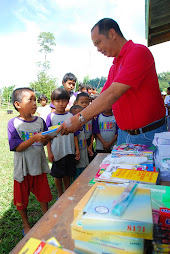
From the US, Josephine Turner said the Galing Foundation Inc. she's involved in in Atlanta has chosen Kipalkuda Elementary School as its Mindanao pilot community for provision of slightly used and new books and school supplies. The foundation sent a box of books last June and will be sending another box in September. (SARANGANI INFORMATION OFFICE/RGP)
This statement sums up what motivated Tom Balatac, 24, to enroll in Grade I this year.
"Mahirap talaga ang walang pinag-aralan. Naranasan ko na, " said Balatac, single, the third among seven children of a farmer in the upland village of Kamaas.
Balatac walks an hour from his village to Kipalkuda Elementary School in New La Union (population: 1,232), a predominantly T'boli barangay. "Lahat ng mga kapatid ko graduate na sa high school. Ako lang ang hindi naka graduate. Kung may tumulong sa akin baka hanggang college ako," Balatac said. Balatac wishes to become a lawyer someday to help his community.
Despite his T'boli family's owning a 24-hectare farm, their living conditions remain poor and that urged him more to go to school.
Besides, Balatac and several children in Kipalkuda Elementary School have won back interest in schooling due to a school feeding program initiated by an American missionary and his wife.
Daniel Lee Evans and his wife Aurea Desaville set up the Datu Wali Mission Foundation (DWM) two years ago to facilitate education among tribal and poor children. "Education breaks the cycle of poverty," said Evans, 54, a retired executive of Bank of America in San Francisco.
According to the DWM website (http://www.datuwalimission.org/), the students live in the mountains above the school and walk up to four hours each way daily to attend classes. They cross up to seven streams and rivers and, because of that and the rainforest, they arrive at school wet and cold.
They are so poor that many begin the day without breakfast and most cannot bring a lunch to school. Those circumstances make class attendance very challenging and inconsistent.
At the appointed school lunch hour, nearly all of the students begin the long walk home since they have no lunch to eat. Not only does this create high absenteeism, but it demoralizes teachers as their classrooms are mostly empty in the afternoons, the DWM said.
Kipalkuda, which means a horse crossing a river in T'boli dialect, was the former name of this barangay. It was renamed "New" by Ilocano settlers from San Fernando, La Union in Luzon.
"We can't help a lot of people, but by coming to our children, I hope that one day, one of our children decides to come back as a professional and help their own people, and that's when we know our success," Evans said.
The Evans couple has used their family farm to plant vegetables for the T'boli pupils' free lunch program. "We looked at the community and we reached out to our friends back in America, and they are very helpful," Evans said. Evans led the feeding program with the parents and the teachers to provide lunch for the children on school days. Parents alternately cook food to keep their children in school. The DWM provides rice, clothing, and transportation. The municipal and provincial government units have donated school supplies and used clothing too. The program has encouraged children to go to school, marking a 220% increase in enrolment this school year.
There are a number of pupils who are already in their teens. The school today has 349 pupils, compared to 90 in 2004. A DWM truck ferries children to and from school everyday. The kids call it their "school bus." "It's amazing because, while the province has to extend the enrolment of some schools to see their population increasing, our school has more than doubled its enrollees," Evans said. "Our challenge now is providing these children with more chairs and a place (classrooms) to study," Evans said. Mayor Elsie Perrett said the municipal government was looking for funds "to assist the school in giving quality education to our children."
The local government has delivered 16 desks for the pupils. But these were not enough. Some pupils still sit four in a desk instead of two.
Two of Kipalkuda's school buildings need repair and were not safe to be used as classrooms. With only four teachers, Perrett said she has requested the Department of Education to assign more teachers in Kipalkuda."But first of all we have to encourage pupils to come to school and encourage older people to get interested to study and learn," the mayor said. Teacher-in-charge Aura Mirayo's T'boli roots helped convince children to enroll."Sabi ko lahat walang mayaman dito sa inyo. Lahat mahirap. Sabi ko ang solusyon dyan is pag-aaral lang," Mirayo told them. "Kailangan mag-aral kayo. Walang bata o matanda sa pag-aaral as long as gusto ninyong matuto." Kipalkuda Elementary School is now one of the top three performers throughout the municipality.
From the US, Josephine Turner said the Galing Foundation Inc. she's involved in in Atlanta has chosen Kipalkuda Elementary School as its Mindanao pilot community for provision of slightly used and new books and school supplies. The foundation sent a box of books last June and will be sending another box in September. (SARANGANI INFORMATION OFFICE/RGP)
Wednesday, August 22, 2007
Schooling in the Barrio

MAITUM, Sarangani (August 22, 2007) – Pupils of Kipalkuda Elementary School in barangay New La Union enjoy going to school Wednesday (August 22) amid a heavy downpour and hours of walking from home to school. They laugh on the way perhaps because their school is supported by the community and the Datu Wali Mission of American businessman Daniel Evans and his wife. The couple has been helping the school for two years, inspiring these children to attend classes and providing them books, a school bus, and free lunch prepared by parents and teachers. (Photo by SARANGANI INFORMATION OFFICE/CAS)
Monday, August 20, 2007
Parents Session

ALABEL, Sarangani (August 18, 2007) - Cecile Dominguez of the Conrado Alcantara Foundation, Inc. facilitates a parents' session during the workshop proper of Education Summit 2007 Saturday (August 18) at the Capitol gym. This event is sponsored by Synergeia Foundation children's hour, the provincial government of Sarangani and Department of Education. (Photo by SARANGANI INFORMATION OFFICE/CAS)
Thursday, August 16, 2007
Out-of-school youth classroom

MALAPATAN, Sarangani (August 9, 2007) – Gov. Migs Dominguez observes the Alternative Learning System classes for the out-of-school youth Thursday (August 9) at Lun Masla community learning center. (SARANGANI INFORMATION OFFICE/CAS)
Gov. Migs with pupils

MALAPATAN, Sarangani (August 8, 2007) – Governor Migs Dominguez mingles with pupils at the turn-over ceremony of a Home Economics, Livelihood and Technology Training Center at Lun Padidu National High School Tuesday (August 7). The center is a joint project of the community and local government with assistance from President Arroyo's Kapit-Bisig Laban sa Kahirapan-Comprehensive and Integrated Delivery of Social Services (KALAHI-CIDSS) program funded by the World Bank. (Photo by SARANGANI INFORMATION OFFICE/CAS)
Alternative Learning System

MALAPATAN, Sarangani (August 9, 2007) – Mayor Aida Singcoy leads the groundbreaking ceremony for the Alternative Learning System (ALS) community learning center in Malapatan Elementary School Thursday (August 9). The project is co-funded by the United States Assistance for International Development (USAID) with its service provider, Education Quality Access for Learning and Livelihood Skills 2 (EQUALLS2). Looking on are Governor Migs Dominguez (right), USAID and EQUALLS2 officials. (Photo by SARANGANI INFORMATION OFFICE/CAS)
Model of Excellence Pilot School
 MALAPATAN, Sarangani (August 9, 2007) – Gov. Migs Dominguez visits Sarangani's pilot school for Models of Excellence, the P. H. Millona Elementary School, Thursday (August 9) with principal Judith Alba. The provincial government built here a library where international foundation Books for the Barrios donated more than 25,000 volumes of books since 2005. (SARANGANI INFORMATION OFFICE/CAS)
Subscribe to:
Posts (Atom)

















.JPG)